
Understanding the Partition
- forum1947
- Apr 20, 2025
- 7 min read
By Komal Singh
A Brief Introduction
Admiral Lord Louis Mountbatten, the last British Viceroy of India, announced on 2nd June 1947 that Britain had agreed to the partition of India into two independent nations, now commonly known as predominantly Hindu India and primarily Muslim Pakistan. This decision subsequently led to the creation of two geographically separate entities: West Pakistan, which is currently named Pakistan, and East Pakistan, which later became Bangladesh. The partition marked a crucial moment in the decolonisation of the subcontinent, redefining the political, social, and cultural landscape of South Asia.

As stated in the journal: The Partition of India and the Prospects of Pakistan, the separatist demand for Pakistan, was not merely a survival of old religious feuds but also an expression of new nationalism, weaponised through immoral religious and social differentiation.
The Two-Nation Theory framed Hindus and Muslims as distinct civilisations; this ideological construct was considered a political tool employed by the Muslim League to consolidate support, transforming religious identity into a vehicle for mass mobilisation.
The movement’s rhetoric, rooted in fears of Hindu political and economic dominance, amplified communal divisions through targeted propaganda, the invocation of Islamic symbolism, and the portrayal of Hindu-Muslim relations as inherently antagonistic.
Within the Muslim community, the movement’s rhetoric reflected genuine concerns regarding political representation and economic security, emphasising their right to self-governance. It framed Hindu-Muslim relations not merely as antagonistic but as a struggle for equitable power-sharing.
The movement’s rhetoric reflected genuine concerns within the Muslim community about political representation and economic security, emphasizing their right to self-governance. It framed Hindu-Muslim relations not merely as antagonistic but as a struggle for equitable power-sharing in a rapidly changing political landscape.
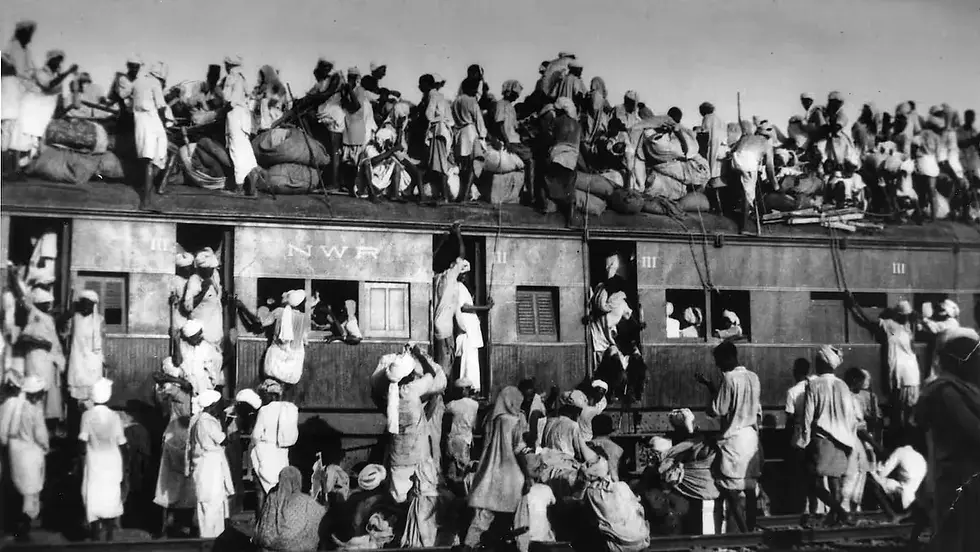
British colonial policies, particularly an over-reliance on divide-and-rule tactics, further exacerbated these tensions, creating an environment where partition became inevitable. As negotiations for independence unfolded, escalating violence, mass displacement, and deep-rooted animosities culminated in one of the most traumatic episodes in South Asian history.
Over a million deaths were recorded, alongside the forced migration of nearly 15 million people.
The partition not only led to the creation of India and Pakistan but also entrenched sectarian divisions that continue to shape the region’s political and social landscape.
Voices of the Past: Personal Narratives from Partition Survivors
Amrita Pritam (1919-2005), born Amrit Kaur, remains one of the most revered figures in Punjabi literature, with her personal experience of the Partition shaping much of her work.

Forced to flee Lahore, she sought refuge in New Delhi, India; the violence and devastation left an indelible mark on her, with the trauma poignantly captured in her most famous poem, Ajj Aakhaan Waris Shah Nu (Today I Ask Waris Shah).
Her writings focus immensely upon the suffering of those caught in the violent upheaval, particularly women, who were victims of sexual violence, abduction, and forced migration. Written in the wake of the massacres that unfolded during the division of the subcontinent, the poem addresses Waris Shah, asking him to witness the horrific suffering of the common citizens. This powerful invocation allowed a collective, channelled grief, reflecting personal loss and the emotional and cultural wounds inflicted across the region, thus resonating deeply with the pain of Partition.
Ikk Royi Sii Dhi Punjab Di
Tu Likh Likh Maarey Wain
Ajj Lakhaan Dhiyan Rondiya
Tenu Waris Shah Nuu Kain
Once, one daughter of Punjab cried;
you wrote a wailing saga
Today, a million daughters,
cry to you, Waris Shah
Through these verses, a transformation of individual pain is displayed as a collective outcry, capturing the anguish of a region torn by violence and displacement. Her poem stands as a testament to the scars of Partition, preserving the memories of loss, exile, and longing that continue to resonate across generations.
Women and the Partition: Cultural and Social Consequences
The partition of India led to profound cultural and social consequences for women, enduring atrocities whose experiences of violence, displacement and disruption. Many women were abducted, raped and forced to leave their homes. Estimates suggest that between 75,000 to 100,000 women were subjected to horrific sexual violence, whilst many more were killed. Their suffering was compounded by social stigma; countless women committed suicide or were killed by their families to protect their honour.
A prominent example of this is depicted within Khushwant Singh’s Train to Pakistan, displaying the impact of the partition on women with sensitivity, highlighting their vulnerability, resilience, and immense trauma experienced. The novel presents a vivid picture of women caught in the violent upheaval, with lives torn apart by communal hatred, abductions, and sexual violence, depicting harsh truths of the brutality that women faced. Many were victims of mass rapes, abductions, and forced conversions, whilst others witnessed their loved ones murdered or taken away.
With the depiction of characters such as Nooran and Zohra, Khushwant Singh offers a portrayal of the anguish and devastation experienced by women at this time. They were often reduced to symbols of family honour or property to be either protected or destroyed.
Women faced physical and emotional trauma by the breakdown of human relations, as familial bonds were torn apart, and once cohesive communities became divided along religious lines.
In the face of political decisions prioritising territorial boundaries and religious divisions, women bore the brunt of the violence in the purview of the preservation of honour, as depicted within Singh’s novel.
However, Singh also depicts the strength and resilience of women; survival meant navigating the painful complexities of trauma and adapting to a world where traditional social norms had collapsed. Women, in the novel, while victimised, are also shown as enduring and assertive.
Singh illustrates how the partition not only reshaped the political and geographical boundaries of the subcontinent but the social scarring of women.
Broken Borders: The Partition’s effect on Religious Communities
Before the Partition, religious communities of Hindus, Sikhs, and Muslims coexisted peacefully, sharing cultural and economic ties despite occasional tensions ranging from social to political.
However, as the demand for a separatist Muslim State grew, fears of marginalisation amongst all religious communities intensified. The division of India led to one of the largest and most violent mass migrations in history, with Muslims fleeing to Pakistan and Hindus and Sikhs escaping to India.
Communal violence erupted across Punjab and Bengal with massacres, forced conversions and sexual violence, leaving deep scars on all communities.
Sikhs, caught within the crossfire of a dominant Hindu India and dominant Muslim Pakistan, suffered significant losses, particularly in West Punjab, where they were forced to abandon their historical gurdwaras. This included Gurdwara Janam Asthan, and Nankana Sahib, the birthplace of Guru Nanak Dev Ji, the founder of Sikhism.
The Sikh community faced hardship and was displaced and disillusioned. Despite establishing a strong presence in post-partition India, Punjab was split into two halves, between both India and Pakistan, thus forcing over 2 million Sikhs to migrate from their ancestral homes in what is now Lahore and Rawalpindi. This forced migration led to Punjab, India becoming predominantly Sikhs.
Post-Partition, Muslims in India faced severe marginalisation. Over 6 million Muslims migrated to Pakistan, leaving behind their homes and properties, whilst those who remained in India faced political and social marginalisation. Many Muhajirs (Muslim refugees from India) struggled to integrate into Pakistan society, facing discrimination from local ethnic groups particularly in Sindh.
Hindus, despite forming the majority in the post-partition period, experienced mass displacement and violence within Pakistan. In West Punjab and Sindh, Hindu communities were attacked, with the destruction of temples and thousands fleeing to India. In East Bengal, now Bangladesh, Hindus continue to face persecution with their population drastically shrinking due to targeted violence and forced conversions.
While many Hindu refugees successfully integrated into India, the trauma of the Partition contributed to the tensions between the Hindu, Sikh and Muslim communities; thus shaping South Asia’s religious, political and social landscape.
The British South Asian Dialogue Forum’s Literary and Cinematic Recommendations
There are many literary examples, displaying the courage and atrocities faced by women in the time of the partition.
These are The British South Asian Dialogue Forum’s Literary Recommendations:
Train to Pakistan, Khushwant Singh
Published in 1956, the novel draws upon Singh’s own experiences during and after the Partition of India in 1947 and details the chaos and violence in the forming of Hindu India and Muslim Pakistan.

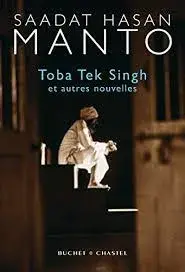
Toba Tek Singh, Saadat Hasan Manto
Published in 1955, Toba Tek Singh by Saadat Hasan Manto uses a third-person narrator to explore the themes of identity, separation, trauma, and bewilderment in the aftermath of the Partition of India. Set in a mental asylum in Lahore, the short story portrays the tragic and ironic plight of the patients, who are caught in the political upheaval and forced to confront their displacement and the arbitrary nature of borders in post-Partition India.
Gadar, Ek Prem Katha
Gadar: Ek Prem Katha (2001), directed by Anil Sharma, is a historical film set against the backdrop of the Partition of India in 1947. The film tells the love story between Tara Singh, a Sikh, and Sakina, a Muslim woman. Tara saves Sakina from a mob during the Partition violence, and they eventually fall in love and marry. However, their happiness is shattered when Sakina's family forces her to return to Pakistan after the Partition, due to religious and political tensions. The film explores Tara’s determined struggle to reunite with his wife, battling both the physical and emotional trauma caused by the Partition.

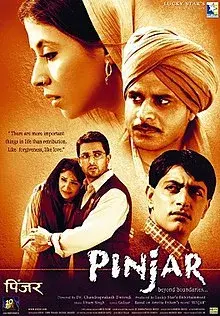
Pinjar
Pinjar (2003) is a powerful film based on the novel by Amrita Pritam, set during the Partition of India in 1947. The story follows Puro, a young Hindu woman who is abducted by a Muslim man named Rashid during the chaos of Partition. As the violence of the partition unfolds, Puro is forced to live with Rashid’s family in Pakistan, torn between her past and her new reality. The film portrays the harrowing impact of the Partition on women, focusing on themes of identity, displacement, and survival, as Puro struggles to reclaim her agency and navigate the emotional and physical trauma inflicted on her.


Comments